[mk_page_section layout_structure=”full” attachment=”fixed” bg_position=”left top” bg_repeat=”no-repeat” bg_stretch=”false” enable_3d=”false” speed_factor=”0.3″ bg_video=”no” video_mask=”false” bg_gradient=”false” gr_end=”#ffffff” video_opacity=”0.6″ top_shadow=”false” section_layout=”full” sidebar=”sidebar-1″ min_height=”100″ full_width=”false” full_height=”false” intro_effect=”false” padding_top=”10″ padding_bottom=”0″ margin_bottom=”0″ first_page=”true” last_page=”true” bg_image=”https://noeticsi.com/wp-content/uploads/2014/12/1-BlueBackground1.jpg” video_source=”self” stream_host_website=”youtube” skip_arrow=”false” skip_arrow_skin=”light”]
[mk_divider style=”padding_space” divider_width=”full_width” custom_width=”10″ align=”center” thickness=”1″ margin_top=”30″ margin_bottom=”0″][mk_image src=”https://noeticsi.com/wp-content/uploads/2014/12/SpeakingFromTheHeartCover.jpg” image_width=”300″ image_height=”394″ crop=”false” svg=”false” lightbox=”false” group=”_general” frame_style=”simple” target=”_self” caption_location=”inside-image” align=”left” margin_bottom=”0″ animation=”left-to-right”]
[mk_divider style=”padding_space” divider_width=”full_width” custom_width=”10″ align=”center” thickness=”1″ margin_top=”50″ margin_bottom=”0″][mk_fancy_title tag_name=”h2″ style=”false” color=”#ffffff” size=”28″ font_weight=”300″ font_style=”inhert” letter_spacing=”1″ margin_top=”15″ margin_bottom=”15″ font_family=”none” align=”center” animation=”fade-in” txt_transform=”none”]Put your heart into it.
Learn it by heart.
Sing with all your heart.
[br]
by Dr. Dominique Surel[/mk_fancy_title]
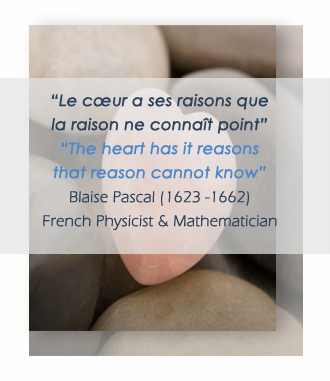
We are all familiar with such expressions, which suggest that the heart is more than a physical pump that sustains life. Throughout history, philosophers, poets, and prophets have regarded the human heart as the source of love, wisdom, intuition, and positive emotions. These important functions of the heart were recognized by many ancient societies, including the Mesopotamians, the Babylonians, the Greeks, and the Chinese. And four thousand years ago the Egyptians believed the heart played a role in the spiritual dimension; upon death, they weighed the person’s heart to see how much good and evil it contained and placed the heart in special urns for burial, while the brain was discarded. The renowned French philosopher Blaise Pascal stated: “The heart has reasons that reason cannot know.” Such examples are endless and demonstrate the gap between the current scientific perspective of the heart and many ancient traditions.
But the scientific view of the brain as the only system involved in all cognitive and emotional functions is actually fairly recent. While psychologists have maintained that emotions are purely mental expressions generated by the brain alone, we are now beginning to see the emergence of a new, more complete understanding of how the brain functions—and how the body, brain, and heart interact in a dynamic and complex relationship. But while most scientists have focused only on the heart and the body’s responses to the brain’s commands, a few researchers have begun to examine the messages the heart sends to the brain and how the brain responds to them.
[mk_divider style=”padding_space” divider_width=”full_width” custom_width=”10″ align=”center” thickness=”1″ margin_top=”10″ margin_bottom=”0″]
[/mk_page_section][mk_page_section layout_structure=”full” attachment=”scroll” bg_position=”left top” bg_repeat=”repeat” bg_stretch=”false” enable_3d=”false” speed_factor=”0.3″ bg_video=”no” video_mask=”false” bg_gradient=”false” gr_end=”#1e73be” video_opacity=”0.6″ top_shadow=”false” section_layout=”full” sidebar=”sidebar-1″ min_height=”60″ full_width=”true” full_height=”false” intro_effect=”false” padding_top=”0″ padding_bottom=”10″ margin_bottom=”0″ first_page=”true” last_page=”true” bg_color=”#fefcf6″]
[mk_fancy_title tag_name=”h2″ style=”false” color=”#5e9cc9″ size=”24″ font_weight=”300″ font_style=”inhert” letter_spacing=”1″ margin_top=”22″ margin_bottom=”8″ font_family=”none” align=”center” animation=”fade-in” txt_transform=”none”]The Central Role of the Heart[/mk_fancy_title]
[/mk_page_section][mk_page_section layout_structure=”full” attachment=”fixed” bg_position=”left top” bg_repeat=”no-repeat” bg_stretch=”false” enable_3d=”true” speed_factor=”0.3″ bg_video=”no” video_mask=”false” bg_gradient=”radial” gr_end=”#ffffff” video_opacity=”0.2″ top_shadow=”false” section_layout=”full” sidebar=”sidebar-1″ min_height=”50″ full_width=”false” full_height=”false” intro_effect=”false” padding_top=”10″ padding_bottom=”10″ margin_bottom=”0″ first_page=”true” last_page=”true” bg_color=”#f7f7f7″ bg_image=”https://noeticsi.com/wp-content/uploads/2014/12/Heart-Article1.jpg” video_color_mask=”#eaeaea” video_source=”self” stream_host_website=”youtube” skip_arrow=”false” skip_arrow_skin=”light”]
One of the primary researchers in this field is Rollin McCraty, Ph.D., Director of Research at The Institute of HeartMath, located in Boulder Creek, California. He is a Fellow of the American Institute of Stress, holds memberships with the International Neurocardiology Network, the American Autonomic Society, the Pavlovian Society, and the Association for Applied Psychophysiology and Biofeedback, and is an adjunct professor at Claremont Graduate University. McCraty, whose background is in electrical engineering, is responsible for several inventions widely used in the semi-conductor and automotive industry today. But in 1991, McCraty decided to pursue his passion and helped Doc Childre found the Institute of HeartMath. The research team they have put together has been exploring the role the heart plays in creating emotional experience and accessing intuition, as well as its role in the physiology of optimal function.
The heart is in a constant two-way dialogue with the brain. But, McCraty explains, the heart and cardiovascular system are sending far more signals to the brain than the brain is sending to the heart.
This has been known since the late 1800s, but has largely been ignored. While it is recognized that these afferent signals, or signals that flow to the brain, have a regulatory influence on many aspects of the autonomic nervous system, including most glands and organs, it is less commonly appreciated that they also have profound effects on the higher brain centers. Cardiovascular afferents have numerous connections to such brain centers as the thalamus, hypothalamus, and amygdala, and they play a direct and important role in determining our perceptions, thought processes, and emotional experiences.
Recent work in the relatively new field of neurocardiology has firmly established that the heart is a sensory organ and an information encoding and processing center, with an extensive intrinsic nervous system that’s sufficiently sophisticated to qualify as a heart brain. Its circuitry enables it to learn, remember, and make functional decisions independent of the cranial brain. To everyone’s surprise, the findings have demonstrated that the heart’s intrinsic nervous system is a complex, self-organized system; its neuroplasticity, or ability to reorganize itself by forming new neural connections over both the short and long term, has been well demonstrated.
[/mk_page_section][mk_page_section layout_structure=”full” attachment=”scroll” bg_position=”left top” bg_repeat=”repeat” bg_stretch=”false” enable_3d=”false” speed_factor=”0.3″ bg_video=”no” video_mask=”false” bg_gradient=”false” gr_end=”#1e73be” video_opacity=”0.6″ top_shadow=”false” section_layout=”full” sidebar=”sidebar-1″ min_height=”60″ full_width=”true” full_height=”false” intro_effect=”false” padding_top=”0″ padding_bottom=”10″ margin_bottom=”0″ first_page=”true” last_page=”true” bg_color=”#5e9cc9″]
[mk_fancy_title tag_name=”h2″ style=”false” color=”#ffffff” size=”24″ font_weight=”300″ font_style=”inhert” letter_spacing=”1″ margin_top=”22″ margin_bottom=”8″ font_family=”none” align=”center” animation=”fade-in” txt_transform=”none”]Heart-Brain Communication Pathways[/mk_fancy_title]
[/mk_page_section][mk_page_section layout_structure=”full” attachment=”scroll” bg_position=”left top” bg_repeat=”repeat” bg_stretch=”false” enable_3d=”false” speed_factor=”0.3″ bg_video=”no” video_mask=”false” bg_gradient=”false” gr_end=”#1e73be” video_opacity=”0.6″ top_shadow=”false” section_layout=”full” sidebar=”sidebar-1″ min_height=”60″ full_width=”true” full_height=”false” intro_effect=”false” padding_top=”0″ padding_bottom=”10″ margin_bottom=”0″ first_page=”true” last_page=”true” bg_color=”#dd3333″]
[mk_fancy_title tag_name=”h2″ style=”false” color=”#ffffff” size=”18″ font_weight=”300″ font_style=”inhert” letter_spacing=”1″ margin_top=”22″ margin_bottom=”8″ font_family=”none” align=”center” animation=”fade-in” txt_transform=”none”]The neural communication pathways [br]between the heart and the brain:[/mk_fancy_title]
[/mk_page_section][mk_page_section layout_structure=”full” bg_color=”#5075bb” attachment=”scroll” bg_position=”left top” bg_repeat=”repeat” bg_stretch=”false” enable_3d=”false” speed_factor=”0.3″ bg_video=”no” video_mask=”false” bg_gradient=”false” gr_end=”#1e73be” video_opacity=”0.6″ top_shadow=”false” section_layout=”full” sidebar=”sidebar-1″ min_height=”100″ full_width=”false” full_height=”false” intro_effect=”false” padding_top=”0″ padding_bottom=”0″ margin_bottom=”0″ first_page=”true” last_page=”true”]
[mk_image src=”https://noeticsi.com/wp-content/uploads/2014/12/SpeakingFromTheHeart4.jpg” image_width=”600″ image_height=”362″ crop=”true” svg=”false” lightbox=”false” group=”_general” frame_style=”simple” target=”_self” caption_location=”inside-image” align=”center” margin_bottom=”10″ animation=”fade-in”]
[/mk_page_section][mk_page_section layout_structure=”full” attachment=”scroll” bg_position=”left top” bg_repeat=”repeat” bg_stretch=”false” enable_3d=”false” speed_factor=”0.3″ bg_video=”no” video_mask=”false” bg_gradient=”false” gr_end=”#1e73be” video_opacity=”0.6″ top_shadow=”false” section_layout=”full” sidebar=”sidebar-1″ min_height=”50″ full_width=”false” full_height=”false” intro_effect=”false” padding_top=”10″ padding_bottom=”10″ margin_bottom=”0″ first_page=”true” last_page=”true” bg_color=”#f7f7f7″]
[mk_divider style=”padding_space” divider_width=”full_width” custom_width=”10″ align=”center” thickness=”1″ margin_top=”30″ margin_bottom=”0″]
The heart’s intrinsic nervous system consists of ganglia, which contain local circuit neurons of several types, and sensory neurites, which are distributed throughout the heart. The intrinsic nervous system processes and integrates information from the extrinsic nervous system and from the sensory neurons within the heart. The extrinsic cardiac ganglia, located in the thoracic cavity, have direct connections to organs such as the lungs and esophagus and are also indirectly connected via the spinal cord to many other organs, including the skin and arteries.
[mk_divider style=”padding_space” divider_width=”full_width” custom_width=”10″ align=”center” thickness=”1″ margin_top=”30″ margin_bottom=”0″]
The “afferent” (flowing to the brain) parasympathetic information travels from the heart to the brain through the vagus nerve to the medulla, after passing through the nodose ganglion. The sympathetic afferent nerves first connect to the extrinsic cardiac ganglia (also a processing center), then to the dorsal root ganglion and the spinal cord.Once afferent signals reach the medulla, they travel to the subcortical areas (thalamus, amygdala, etc.) and then to the cortical areas.
[/mk_page_section][mk_page_section layout_structure=”full” attachment=”scroll” bg_position=”left top” bg_repeat=”repeat” bg_stretch=”false” enable_3d=”false” speed_factor=”0.3″ bg_video=”no” video_mask=”false” bg_gradient=”false” gr_end=”#1e73be” video_opacity=”0.6″ top_shadow=”false” section_layout=”full” sidebar=”sidebar-1″ min_height=”50″ full_width=”false” full_height=”false” intro_effect=”false” padding_top=”10″ padding_bottom=”10″ margin_bottom=”0″ first_page=”true” last_page=”true” bg_color=”#dd6a6a”]
[mk_divider style=”padding_space” divider_width=”full_width” custom_width=”10″ align=”center” thickness=”1″ margin_top=”22″ margin_bottom=”0″][mk_image src=”https://noeticsi.com/wp-content/uploads/2014/12/SpeakingFromTheHear_Final1.png” image_width=”294″ image_height=”412″ crop=”true” svg=”false” lightbox=”false” group=”_general” frame_style=”simple” target=”_self” caption_location=”inside-image” align=”left” margin_bottom=”10″]
[mk_divider style=”padding_space” divider_width=”full_width” custom_width=”10″ align=”center” thickness=”1″ margin_top=”22″ margin_bottom=”0″]
Some of the most seminal work on the relationship between heart–brain interactions was conducted in the 1970s and early 1980s by physiologists John and Beatrice Lacey, who were the first to postulate a causal role for the cardiovascular system in modulating perceptual and cognitive performance. They suggested that the cardiovascular system modulates cortical functions via ascending input during a cardiac cycle from the sensory neurons in the heart, aortic arch, and carotid arteries.
McCraty and his team at HeartMath followed up this notion and developed what they call the heart rhythm coherence hypothesis, which postulates that the pattern and stability of beat-to-beat changes in heart rate encodes information over macroscopic time scales that can influence cognitive performance and emotional experience. The HeartMath researchers also found substantial evidence that the heart plays a unique synchronizing role in the body. As the most powerful and consistent generator of rhythmic information patterns in the body, the heart is in continuous communication with the brain and body through multiple pathways: neurologically, (through the Autonomic Nervous System) biochemically (through hormones), biophysically (through pressure and sound waves), and energetically (through electromagnetic field interactions). This makes the heart uniquely well positioned to act as the global coordinator in the body’s symphony of functions, binding and synchronizing the system as a whole. Because of the extent of the heart’s influence on physiological, cognitive, and emotional systems, the heart provides a central point of reference from which the dynamics of such processes can be regulated.
[/mk_page_section][mk_page_section layout_structure=”full” attachment=”scroll” bg_position=”left top” bg_repeat=”repeat” bg_stretch=”false” enable_3d=”false” speed_factor=”0.3″ bg_video=”no” video_mask=”false” bg_gradient=”false” gr_end=”#1e73be” video_opacity=”0.6″ top_shadow=”false” section_layout=”full” sidebar=”sidebar-1″ min_height=”60″ full_width=”false” full_height=”false” intro_effect=”false” padding_top=”0″ padding_bottom=”10″ margin_bottom=”0″ first_page=”true” last_page=”true” bg_color=”#fefcf6″ video_source=”self” stream_host_website=”youtube” skip_arrow=”false” skip_arrow_skin=”light”]
[mk_fancy_title tag_name=”h2″ style=”false” color=”#5e9cc9″ size=”24″ font_weight=”300″ font_style=”inhert” letter_spacing=”1″ margin_top=”22″ margin_bottom=”8″ font_family=”none” align=”center” animation=”fade-in” txt_transform=”none”]
Learn More About the Heart
[/mk_fancy_title]
The HeartMath research team has identified and named what is now known as the heart’s coherent state. It is important to note that, as McCraty points out, the heart coherent state is a well-defined and measurable state that is fundamentally different from a state of relaxation and from most meditative states that require only a lowered heart rate and not necessarily a coherent rhythm.
This state, which reflects a type of optimal function, is technically called physiological coherence, but it is also being referred to in the literature as heart coherence, cardiac coherence, or resonance. The important point is that this is a specific functional psycho-physiological mode that can be objectively measured by heart rate variability (HRV) analysis. Heart rate variability is a measure of the naturally occurring beat-to-beat changes in heart rate.
“It was really Doc Childre who first used the terms ‘heart intelligence’ and ‘coherence,’ at least that I know of,” says McCraty. “He was using this language when I first met him in 1987, but it took us a few years of doing the research to really start to understand just how appropriate these terms really were.”
McCraty and the research team then began to understand that there is a physiological reason that our emotions are reflected in the heart’s rhythmic patterns, and this took the perception of the heart being involved in our emotions out of the metaphysical realm and grounded it in basic emotional physiology. This set the stage for their later studies on intuition.
McCraty found compelling evidence to suggest that the heart’s energy field (energetic heart) is coupled to a field of information that is not bound by the classical limits of time and space. This evidence comes from several rigorous experimental studies that investigated the proposition that the body receives and processes information about a future event before the event actually happens. One of these studies, conducted at the HeartMath laboratories, showed that both the heart and brain receive and respond to pre-stimulus information about a future event. But even more surprising is the finding that the heart seems to receive the intuitive information before the brain. They also found that study participants in a positive, emotion-driven, coherent state prior to the experimental protocols proved to be significantly more attuned to the information from the heart than those who were not in such a state. This suggests to McCraty that the heart is directly coupled to a subtle energetic field of information that is entangled and interacts with the multiplicity of energetic fields in which the body is embedded—including the quantum vacuum.
That the heart appears to receive intuitive information before the brain should not be all that surprising, says Mc-Craty. It just confirms what people mean when they speak of the intuitive heart or heart intelligence. The energetic heart is coupled to a deeper part of ourselves. When we are heartcentered and coherent, we have a tighter coupling and closer alignment with our deeper source of intuitive intelligence. In a heart coherent state there is an increased flow of intuitive information that is communicated via the emotional energetic system to the brain systems resulting in a stronger connection with our inner voice and allowing us access to the largely untapped potential for bringing our mental and emotional faculties into greater balance and self-directed control. Practicing shifting to a more coherent state increases intuitive awareness and leads to shifts in perception and worldviews from which better informed and more intelligent decisions can be made.
The heart’s electromagnetic field, by far the most powerful rhythmic field produced by the human body, not only envelops every cell of the body but also extends out in all directions into the space around us. The cardiac field can be measured several feet away from the body by sensitive magnetometers. Research conducted at HeartMath suggests that the heart’s field is an important carrier of information.
“We propose,” says McCraty, “that the electromagnetic fields produced by the heart form a complex energetic network that connects the electromagnetic fields of the rest of the body. In doing so, the heart’s energetic field acts as a modulated carrier wave that encodes and communicates information throughout the entire body, from the systemic to the cellular levels, and even conveys information outside the body between individuals.
“The concept of an energetic information field is not a new one. Indeed, many prominent scientists have proposed models in which information from all physical, biological and psychosocial interactions is enfolded as a spectral order outside the space/time world in the energy waveforms of the quantum vacuum. Holographic principles form the basis of most of these theories and have been used to describe how information about the organization of a whole is nonlocalized—enfolded and distributed to all parts and locations via the energy waveforms produced by interactions in the brain, social structures, and the universe. We adopted a holographic perspective to describe how energy waveforms generated by the heart’s electromagnetic field encode and distribute information about all structures and processes throughout the body from the cellular level to the body as a whole.”
After deep reflection, McCraty’s continuously evolving vision took the concept of coherence and energetic fields to the macro level of the planet—and the very edge of science. “Coherence,” he says, “is a state of energetic alignment and cooperation between heart, mind, body, and spirit. In coherence, energy is accumulated, not wasted, leaving you more energy to manifest intention and harmonious outcomes.”
In the hopes of helping to generate more coherence throughout the world, McCraty also helped start the Global Coherence Initiative, a science-based, co-creative project to unite people in heart-focused care and intention, to facilitate the shift in global consciousness from instability and discord to balance, cooperation, and enduring peace. The idea is to unite individuals who will use heart coherence with specific intentions in order to raise human consciousness at the global level. A good idea, indeed.
McCraty, R., “The energetic heart: Bioelectromagnetic communication within and between people,” in Bioelectromagnetic edicine, P.J. Rosch and M.S. Markov, Editors. 2004, Marcel Dekker: New York. p. 541–562.
McCraty, R., Atkinson, M., Tomasino, D., & Bradley, R. T, “The coherent heart: Heart-brain interactions, psychophysiological coherence, and the emergence of system-wide order.” Integral Review, 2009. 5(2): p. 10–115.
McCraty, R., Childre, D, “Coherence: Bridging Personal, Social and Global Health.” Alternative Therapies in Health and Medicine, 2010. 16(4): p. 10–24.
McCraty, R., M. Atkinson, and R.T. Bradley, “Electrophysiological evidence of intuition: Part 1. The surprising role of the heart.” Journal of Alternative and Complementary Medicine, 2004. 10(1): p. 133–143.
McCraty, R., M. Atkinson, and R.T. Bradley, “Electrophysiological evidence of intuition: Part 2. A system-wide process?” Journal of Alternative and Complementary Medicine, 2004. 10(2): p. 325–336.
McCraty, R., et al., “New Hope for Correctional Officers: An Innovative Program for Reducing Stress and Health Risks.” Appl Psych and Biofeedback, 2009. 34(4): p. 251–272.
McCraty, R., et al., “The effects of emotions on short-term power spectrum analysis of heart rate variability.” American Journal of Cardiology, 1995. 76(14): p. 1089–1093.
[/mk_page_section][mk_page_section layout_structure=”full” attachment=”scroll” bg_position=”left top” bg_repeat=”repeat” bg_stretch=”false” enable_3d=”false” speed_factor=”0.3″ bg_video=”no” video_mask=”false” video_opacity=”0.6″ top_shadow=”false” section_layout=”full” sidebar=”sidebar-1″ min_height=”0″ full_height=”false” intro_effect=”false” padding_top=”20″ padding_bottom=”0″ first_page=”true” last_page=”true” bg_color=”#5e9cc9″ bg_gradient=”false” gr_end=”#1e73be” full_width=”false” margin_bottom=”0″]
[mk_fancy_title tag_name=”h2″ style=”false” color=”#ffffff” size=”18″ font_weight=”normal” font_style=”inhert” txt_transform=”none” letter_spacing=”1″ margin_top=”0″ font_family=”none” align=”center” margin_bottom=”20″]Want to learn more about how
Heart Science can be
valuable to you and/or your organization?[/mk_fancy_title]
[mk_button dimension=”flat” corner_style=”pointed” size=”large” outline_skin=”dark” outline_active_color=”#ffffff” outline_hover_color=”#333333″ btn_hover_bg=”#2b2d31″ text_color=”light” icon_anim=”none” target=”_self” align=”left” fullwidth=”false” margin_top=”0″ bg_color=”#d1b46c” margin_bottom=”0″ button_custom_width=”0″ url=”https://noeticsi.com/contact-us/”]GET IN TOUCH[/mk_button]
[/mk_page_section]